When Did Early Christians Have Scripture to Read
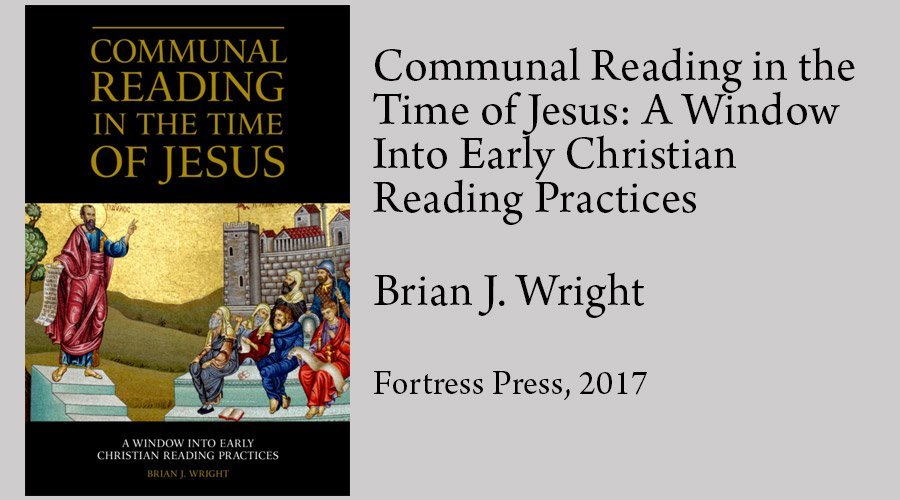
How did early Christians learn and pass on their traditions well-nigh Jesus and his teachings? What did the first communities of Jesus followers do to maintain the authenticity of their understanding of the pregnant of his work, and its continuity to new generations? Further, what place did the growing collection of apostolic writings to scattered churches have in showtime century Christian gatherings?
For some time the academic study of early on Christianity has maintained an accent on the role of oral tradition and social memory in the initial spread and growth of the new Jesus movement. Information technology was assumed that due to things like the scarcity of both writing materials and professional readers, bodily communal reading from sacred texts must have been somewhat rare and limited especially to more urban areas, at least until afterward in the second century.
But now in that location is an increasing recognition that early on Christianity, like the Judaism from which information technology was born, was a "bookish" religion through and through. (See our earlier article How the Offset Christians Challenge The states to Exist Bible Readers.) Larry Hurtado, a New Testament scholar and historian of early Christianity, has been a key voice helping united states explore the evidence for this more closely. His books Destroyer of the Gods (2016) and The Earliest Christian Artifacts (2006) have directly examined this theme. Brian Wright's new book continues this try to bring more clarity to our agreement of the place of reading in the earliest church.
Wright's key point is that communal reading was geographically widespread and that such reading was a mode of avoiding whatsoever serious alterations in the traditions and teachings of the starting time Christians.
There are two backgrounds to this: first, the fact that public reading was a common feature of life beyond much of the Roman Empire. Letters, proclamations, poesy, and the corking literary sagas of the time were all frequently read in public places. These did have a kind of functioning attribute to them, but the signal is that they were non performed from memory, but rather read aloud from written texts.
The second key groundwork is of course the Jewish matrix from which Christianity emerged. Just as the Jews met and read the Scriptures together regularly, then did the early on Christians. (See the chapter "Sharing Our Synagogue Bible" in my volume Saving the Bible from Ourselves.)
Wright's book is an of import piece of detailed, collected evidence from the start century, in both the broader Roman culture and in specifically Christian settings. He includes chapters on relevant social, economic, and political factors, arguing that all of these were actually conducive to the widespread do of public reading, making it a familiar characteristic of life for everyone. In the example of the Christian communities, it'south more clear than we've realized that the New Attestation documents themselves are filled with evidence that they were expected to be widely shared and then publicly read.
In short, a standard part of the experience of the first Christians was the public, out-loud reading of the founding documents of the religion.
Should We Recover Communal Reading Today?
Of course most of the get-go Christians didn't have any opportunity to own a personal copy of the Scriptures, and the preponderance of evidence remains that most people could non even read or write. Only they were experienced, focused listeners, and this served them well. Christian formation in the early church was centered on immersion in the story of God, Israel, and the world as found in the sacred writings, both old and new. This tangible, applied focus on the Scriptures also helped ensure the integrity of the message over fourth dimension.
But what virtually us?
In the mod era we've largely turned away from the early on Christian practice of communal immersion in the Scriptures. Reading and study of the Bible is largely done individually, surrounded past all way of reference-type helps, commentary, and devotional aids. The inquiry show is articulate that this is not working equally an overall strategy for Bible engagement. People written report that reading lone in this way is complicated and overwhelming. In short, information technology'southward hard. And as a result, folks acknowledge they're not doing information technology much.
What new kinds of communal encounters can we imagine? What new forms of public reading and dialogue around the text tin can we envision?
The consequences accept been serious for both individual and public expressions of the faith. Unfamiliarity with the Big Story has produced Christians who don't really take a good hazard of living into the story in our contemporary setting because they don't know who they are or where they came from.
At that place is no shortcut to this biblical noesis. Information technology comes only from sustained attention to our founding narratives, letters, songs, and wisdom. It comes from reading big and reading whole, not piecemeal sampling.
Then what if we were to reclaim the practice and simplicity of the early Christ-followers?
What if we were to rediscover the unique value of communal reading of the Bible?
There have been a number of shifts in the nature of congregational life in recent history. A new emphasis on small groups, a motion toward contemporary music and worship styles, and others. Why couldn't nosotros commit to similarly shifting how and when and where nosotros engage the Bible? What new kinds of communal encounters can we imagine? What new forms of public reading and dialogue around the text can nosotros envision? There are lots of different kinds of churches, lots of different ways this might wait.
A delivery to biblical fluency should be at the center of every church's life.
We tin all inquire: What could my community do?
When Did Early Christians Have Scripture to Read
Source: https://instituteforbiblereading.org/communal-reading-time-jesus-first-christians-learn-bible/
0 Response to "When Did Early Christians Have Scripture to Read"
Post a Comment